
research profile
Dr. Andrew Baschnagel’s Research
My research objective is to translate novel findings from the laboratory into the clinic with the goal of improving treatment for cancer patients.
Precision medicine in radiation oncology involves individually optimizing and tailoring radiation treatments to improve outcomes and decrease side effects. This can be done by selectively combining molecular targeted drugs with radiation to improve the therapeutic ratio and using biomarkers to predict radiation tumor and normal tissue response. These are areas that my research focuses on.
Last updated:
Translational research in lung cancer brain metastases
Current efforts are focused on understanding the molecular basis for the development and progression of NSCLC brain metastases as well as developing and evaluating novel therapeutic strategies for NSCLC brain metastases. This includes the development of patient derived xenografts (PDXs) from patients with NSCLC as well as investigating molecular targets for radiosensitization. Other ongoing work involves RNA sequencing of matched NSCLC primary tumors and associated brain metastases and investigating biomarkers of treatment response. This work is in collaboration with Dr. Randy Kimple, MD ,PhD.
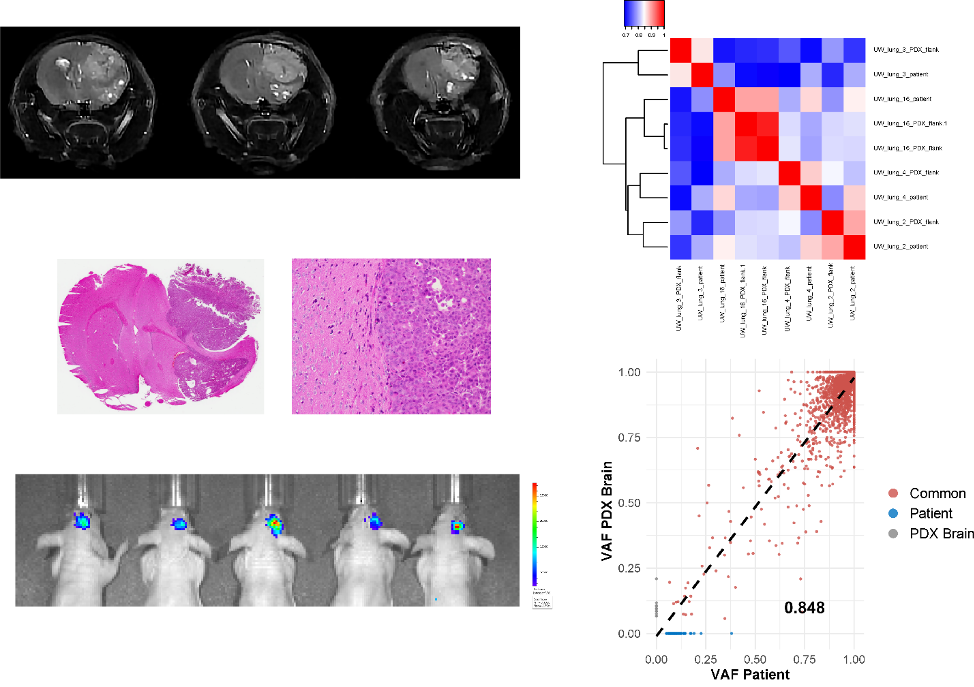
- Baschnagel AM, Kaushik S, Durmaz A, Goldstein S, Ong IM, Abel L, Clark PA, Gurel Z, Leal T, Buehler D, Iyer G, Scott JG, Kimple RJ. Development and Characterization of Patient-Derived Xenografts from Non-Small Cell Lung Cancer Brain Metastases. Sci Rep. 2021;11(1):2520. PMCID:PMC7843608
- Baschnagel AM, Elnaggar JH, VanBeek HJ, Kromke AC, Skiba JH, Kaushik S, Abel L, Clark PA, Longhurst CA, Nickel KP, Leal TA, Zhao SG, Kimple RJ. ATR inhibitor M6620 (VX-970) enhances the effect of radiation in non-small cell lung cancer brain metastasis patient derived xenografts. Mol Cancer Ther. 2021 Aug 19:molcanther.0305.2021. PMCID: PMC8571002
- Enright TL, Witt JS, Burr AR, Yadav P, Leal T, Baschnagel AM. Combined Immunotherapy and Stereotactic Radiotherapy Improves Neurologic Outcomes in Patients with Non-small-cell Lung Cancer Brain Metastases. Clin Lung Cancer. 2021;22(2):110-119. PMID: 33281062.
- Liu, M, Jagodinsky CJ, Callahan SC, Minne RL, Johnson DB, Tomlins SA, Iyer G, Baschnagel AM. Genomic and Immune Landscape of Non-small Cell Lung Cancer Brain Metastases. JCO Precis Oncol. 2025 Jan;9:e2400690. doi: 10.1200/PO-24-00690. Epub 2025 Feb 21. PMID: 39983077
Novel approaches to treating MET altered NSCLC
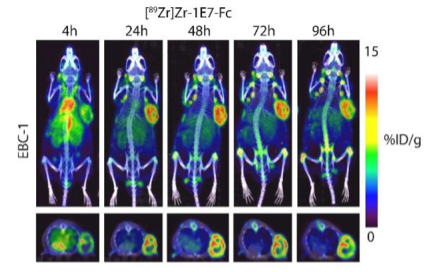
This includes translational work focused on targeting the MET receptor in NSCLC, specifically combining radiation with MET directed therapy and the development and evaluation of novel MET-directed antibodies as theranostic agents. Working in collaboration with Dr. Aaron Lebeau, PhD, we have developed potent MET-binding antibodies from camelids and sharks.
- Ramesh S, Cifci A, Javeri S, Minne R, Longhurst CA, Nickel KP, Kimple RJ, Baschnagel AM. MET Inhibitor Capmatinib Radiosensitizes MET Exon 14-Mutated and MET-Amplified Non-Small Cell Lung Cancer. Int J Radiat Oncol Biol Phys. 2023 Nov 16:S0360-3016(23)08139-7. doi: 10.1016/j.ijrobp.2023.11.013.
- Luo NY, Minne RL, Gallant JP, Gunaratne GS, West JL, Javeri S, Robertson AJ, Lake EW, Engle JW, Mixdorf JC, Aluicio-Sarduy E, Nickel KP, Hernandez R, Kimple RJ, Baschnagel AM*, LeBeau AM*. Development of an Engineered Single-Domain Antibody for Targeting MET in Non-Small Cell Lung Cancer. Bioconjug Chem. 2024 Mar 20;35(3):389-399. doi: 10.1021/acs.bioconjchem.4c00019. Epub 2024 Mar 12. PMID: 38470611 *Co-Corresponding Authors
- Woong JL, Nickel KP, Minne RL, Jeffery JJ, Aluicio-Sarduy E, Kim C, Kim D, Rawding PA, Poellmann MJ, Mamidi N, Engle JW, Lee JH, Park H, Hernandez R, Kimple RJ*, Baschnagel AM*, Hong S*. Multifunctional dendrimer-peptide conjugates for MET receptor-specific imaging of cancer cells. Nanotoday, Vol 59, Dec 2024, 102509. *Co-Corresponding Authors
- Minne RL, Luo NY, Traynor AM, Huang M, DeTullio L, Godden J, Stoppler M, Kimple RJ, Baschnagel AM. Genomic and Immune Landscape Comparison of MET Exon 14 Skipping and MET-Amplified Non-small Cell Lung Cancer. Clin Lung Cancer. 2024 May 10:S1525-7304(24)00080-9. doi: 10.1016/j.cllc.2024.05.001.
- Liu, M, Minne RL, Javeria S, Johnson DB, Tomlins SA, Kimple RJ, Baschnagel AM. Immune and genomic heterogeneity of MET-altered non-small cell lung cancer. JCO Precis Oncol. 2025 Sep;9:e2500048. doi: 10.1200/PO-25-00048. Epub 2025 Sep 26.PMID: 41004700
Functional Lung Avoidance Radiotherapy
This research aims to advance functional lung–avoidance techniques to reduce pulmonary toxicity during thoracic radiation. Using 4DCT to identify highly ventilated lung regions, this planning strategy minimizes radiation to functional tissue, lowering the risk of radiation-induced damage while maintaining tumor control. In collaboration with John Bayouth, PhD, we have completed the first randomized phase II clinical trial evaluating functional lung avoidance radiotherapy (NCT02843568). This study demonstrated that this strategy significantly decreases the risk of radiation-induced pneumonitis in patients receiving standard fractionated radiotherapy. We are currently developing a follow-up phase III study.
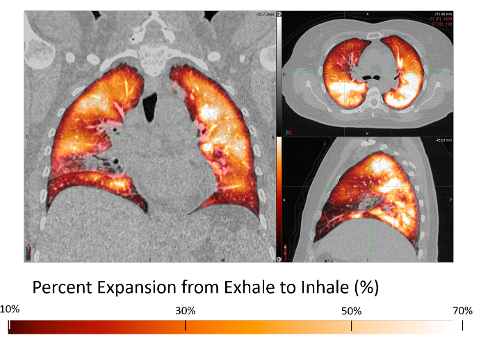
- Wallat EM, Flakus MJ, Wuschner AE, Shao W, Christensen GE, Reinhardt JM, Baschnagel AM, Bayouth JE. Modeling the impact of out-of-phase ventilation on normal lung tissue response to radiation dose. Med Phys. 2020;47(7):3233-3242. PMID: 32187683; PMCID: PMC9486957
- Flakus MJ, Kent SP, Wallat EM, Wuschner AE, Tennant E, Yadav P, Burr A, Yu M, Christensen GE, Reinhardt JM, Bayouth JE, Baschnagel AM. Metrics of dose to highly ventilated lung are predictive of radiation-induced pneumonitis in lung cancer patients. Radiother Oncol. 2023;182:109553. PMID: 36813178; PMCID: PMC1028304
- Baschnagel AM, Flakus MJ, Wallat EM, Wuschner AE, Chappell RJ, Bayliss RA, Kimple RJ, Christensen GE, Reinhardt JM, Bassetti MF, Bayouth JE. A Phase 2 Randomized Clinical Trial Evaluating 4-Dimensional Computed Tomography Ventilation-Based Functional Lung Avoidance Radiation Therapy for Non-Small Cell Lung Cancer. Int J Radiat Oncol Biol Phys. 2024;119(5):1393-1402. PMID: 38387810.
Advancing the care of patients with thoracic malignancies and brain metastases
I have been involved in and lead multiple clinical studies that have helped improve patient care. These studies have been focused on non-small cell lung cancer and include large prospective clinical trials.
- Rydzewski NR, Yadav P, Musunuru HB, Condit KM, Francis D, Zhao SG, Baschnagel AM. Radiomic Modeling of Bone Density and Rib Fracture Risk After Stereotactic Body Radiation Therapy for Early-Stage Non-Small Cell Lung Cancer. Adv Radiat Oncol. 2022. doi: 10.1016/j.adro.2021.100884 PMC9133372
- Bassetti MF, Morris BA, Sethakorn N, Lang JM, Schehr JL, Zhao SG, Morris ZS, Buehler D, Eickhoff JC, Harari PM, Traynor AM, Campbell TC, Baschnagel AM, Leal TA. Combining Dual Checkpoint Immunotherapy with Ablative Radiation to All Sites of Oligometastatic Non-Small Cell Lung Cancer: Toxicity and Efficacy Results of a Phase 1b Trial. Int J Radiat Oncol Biol Phys. 2024 Apr 1;118(5):1481-1489. doi: 10.1016/j.ijrobp.2023.11.040. Epub 2023 Dec8.
- Gondi V, Deshmukh S, Brown PD, Wefel JS, Armstrong TS, Tome WA, Gilbert MR, Konski A, Robinson CG, Bovi JA, Benzinger TLS, Roberge D, Kundapur V, Kaufman I, Shah S, Usuki KY, Baschnagel AM, Mehta MP, Kachnic LA. Sustained Preservation of Cognition and Prevention of Patient-Reported Symptoms With Hippocampal Avoidance During Whole-Brain Radiation Therapy for Brain Metastases: Final Results of NRG Oncology CC001. Int J Radiat Oncol Biol Phys. 2023;117(3):571-580. PMID: 37150264; PMCID: PMC11070071
- Gondi V, Pugh SL, Mehta MP, Wefel JS, Tomé WA, Sun AY, Grecula J, Redmond KJ, Fogh S, Gaspar L, Konski A, Bovi J, Robinson CG, Corn B, Videtic GM, Lok BH, Yoon HA, Heinzerling JH, DeNittis AS, McGarry RC, Devisetty K, Kundapur V, Wu AJ, McCarron EC, Thibault I, Simon EL, Baschnagel AM, Narayan S, Pollock J, Paulus R, Kachnic LA, for the NRG Oncology. Hippocampal Avoidance During Prophylactic Cranial Irradiation for Patients with Small-Cell Lung Cancer: Randomized Phase II/III Trial NRG-CC003. J Clin Oncol. 2025 Aug 11:JCO2500221. doi: 10.1200/JCO-25-00221. PMID: 40789106
- Vuong, S, Liu, M, Tsarovsky, N, Wudtke, JD, Bayliss A, Bassetti, MF, Baschnagel, AM. Outcomes of Patients with Interstitial Lung Disease and Early-Stage Non-Small Cell Lung Cancer Treated with Stereotactic Body Radiotherapy. Clin Lung Cancer. 2025 Aug 5:S1525-7304(25)00161-5. doi: 10.1016/j.cllc.2025.07.017. PMID: 40883165