research profile
Dr. Zac Labby’s Research
Improving the precision and accuracy of what we do will allow us to help more patients, more effectively than ever before.
In radiation therapy, we know that dose delivered through small fields must be measured differently, but how, exactly? We know that modern treatment systems can compensate for spatial inaccuracies, but will such strategies always work? I’m interested in finding and eradicating imprecision in the technical aspects of radiation therapy.
Last updated:
Treatment Planning Strategies for Stereotactic Radiosurgery
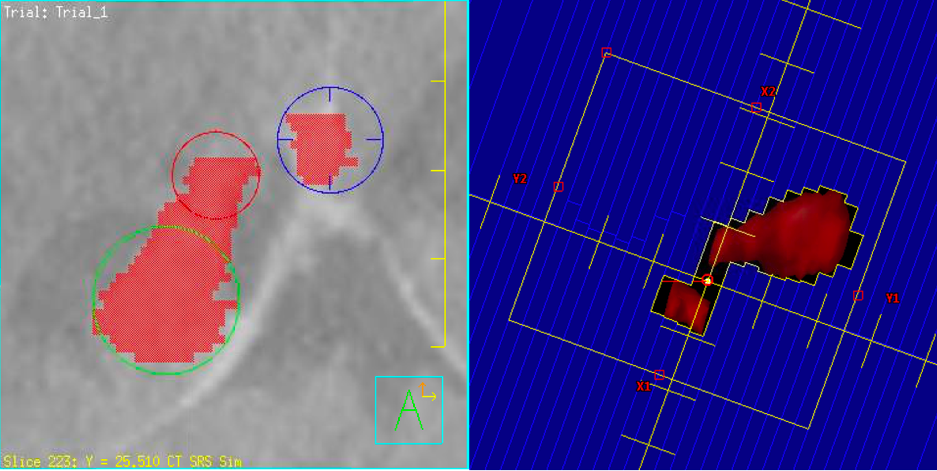
For intracranial radiosurgery treatments, we seek conformal high-dose radiation dose distributions with exceptionally sharp fall-off of the dose outside the treatment volume. Depending on the exact size, shape and location of the target volume, we have access to different treatment planning approaches to achieve these goals. We could treat the target with multiple “shots” of radiation built up from spherical doses with circular conical collimators, or we could treat the target with customized multi-leaf collimator sequences. Sometimes we wish to center the radiation beams exactly in the center of one target, and sometimes we wish to treat multiple targets all with the same localization. We’re working to quantify the exact trade-offs between various treatment planning strategies to better decide the optimal strategy for every unique patient.
Patient Plan-Specific Detector Corrections for Accurate Radiation Measurements
It is well known in radiation physics that ionization chambers respond differently to small fields of radiation (compared to larger fields) due to spectral response characteristics and variable perturbation effects. What is less well known is the magnitude of these effects for any particular patient plan, or for a patient plan characterized by modulation indices, etc. We are working with a graduate student in the UW Radiation Calibration Laboratory to better quantify these effects to enable more accurate radiation dose measurements for individual patients and to enable more precise computer modeling of radiation delivery systems.
Improving the Mechanical Precision of Radiation Therapy Delivery
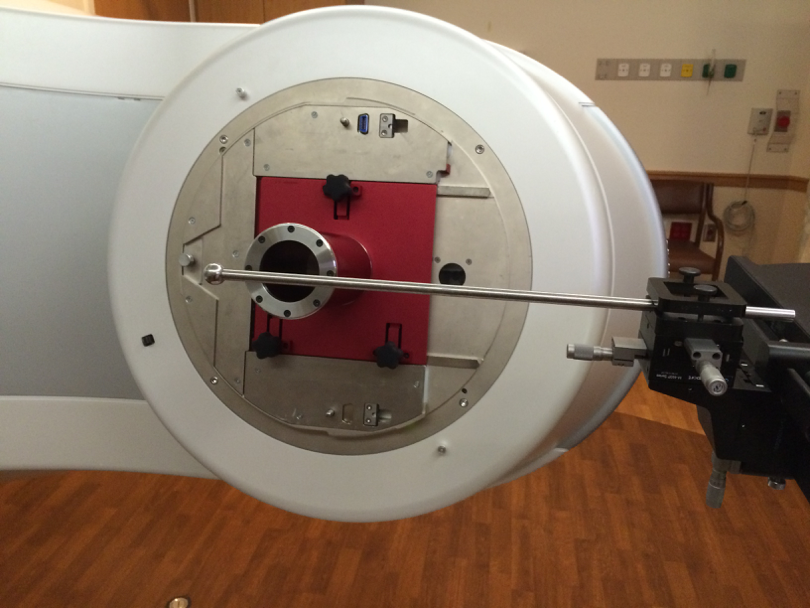
I’m especially fascinated with the potential to improve the mechanical precision of radiation therapy treatment delivery through a variety of strategies. I’m working on techniques to better align conical collimators with the delivery system axes and to ensure that alignment is stable over time. I’m working on more complete and more efficient tests to check the accuracy of multi-leaf collimator positioning, down to 0.05 mm or better. I’m also working on active strategies to compensate for mechanical flex and misalignment, with the goal of overall combined mechanical accuracy on the order of 0.2 mm.